Foreign Body Ingestion
Urgent Care for Pets With Suspected Foreign Body Ingestion
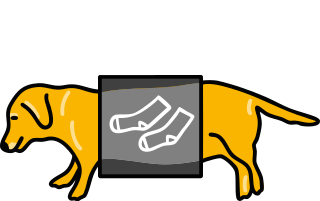
Dogs eat things they shouldn’t. It’s practically in their job description. From socks and toys to bones and corn cobs, foreign object ingestion is one of the most common reasons pets need urgent veterinary care. And cats aren’t immune either, with string, ribbon, and hair ties being frequent offenders.
At Ruby Veterinary Urgent Care in Johns Creek, our ER-trained veterinarians use X-rays to determine whether a swallowed object is likely to pass on its own or requires intervention, giving you a clear answer and action plan the same day.
Commonly Ingested Foreign Objects
Dogs and cats are indiscriminate eaters, and the list of objects veterinarians have retrieved from pets is nearly endless. Among the most common are:
- Socks, underwear, and other clothing items, which are a leading cause of intestinal obstruction in dogs.
- Children’s toys and toy parts, including squeakers from dog toys, are frequently ingested.
- Bones, both cooked and raw, can splinter and cause obstruction or perforation.
- Corn cobs are a classic cause of intestinal blockage because they don’t break down in the GI tract.
- String, yarn, ribbon, and dental floss are particularly dangerous in cats because they can cause a linear foreign body that bunches and saws through the intestines.
- Hair ties and rubber bands are commonly swallowed by cats.
- Rocks, sticks, and mulch are often ingested by puppies during outdoor exploration.
- Coins, batteries, and small household items pose additional toxicity risks beyond obstruction.
Signs Your Pet May Have Swallowed a Foreign Object
Symptoms can appear immediately or develop over hours to days depending on whether the object causes an obstruction.
- Watch for vomiting, especially repeated vomiting or vomiting every time your pet tries to eat or drink
- Loss of appetite or refusal to eat
- Abdominal pain, which may present as a hunched posture, restlessness, or crying when picked up
- Lethargy and depression
- Diarrhea, constipation, or straining to defecate
- Drooling, lip licking, or repeatedly swallowing (signs of nausea)
- Visible string or other material hanging from the mouth or rectum, which you should never pull on
How Ruby Evaluates and Manages Foreign Body Ingestion
The good news is we have a lot of options at our disposal. Our veterinarian will adjust their approach depending on what was swallowed, how long ago, and whether your pet is showing symptoms.
We have the ability to induce vomiting if the object was ingested very recently (typically within 1 to 2 hours) and is safe to bring back up. This is not appropriate for sharp objects, batteries, or caustic substances.
Abdominal X-rays can identify many types of foreign objects, gas patterns suggesting obstruction, and free air that would indicate perforation. Some objects like fabric and rubber are not visible on X-rays, but secondary signs of obstruction may still be apparent. Bloodwork may be used to evaluate organ function and overall health status.
In some cases, if the object is small, smooth, and your pet is stable and comfortable, our veterinarian may recommend a bulking diet to help the object pass on its own, which typically occurs within 24 to 72 hours.
Surgical referral is recommended for objects that are too large to pass, are causing obstruction, or when there are signs of perforation. We stabilize your pet and coordinate direct transfer to a surgical facility with all imaging and records.
What to Expect During Your Visit
Foreign body evaluations at Ruby typically take 45 to 90 minutes depending on the diagnostics needed and treatment path chosen. All X-rays are evaluated by a board-certified veterinary radiologist. Your veterinarian will explain the findings, discuss the likelihood of the object passing versus requiring intervention, and outline a clear plan. If surgery is needed, our team begins coordination immediately.
Prevention Tips
The best way to deal with a foreign body is to prevent one. A few habits go a long way: keep socks, underwear, and small clothing items in closed hampers and drawers, because laundry is one of the most common culprits we see. Supervise toy play and toss damaged toys, especially once the squeaker or stuffing starts coming out. Never give your pet cooked bones, and make sure corn cobs, fruit pits, and similar GI hazards go into a trash can with a lid.
If you have a cat, keep string, ribbon, yarn, hair ties, and dental floss tucked away. Cats can't resist them.
For puppies, take a walk through your yard and clear out mulch, rocks, and sticks from their play areas.
And if your pet is a known chewer, crate training when you're not home can save you a lot of worry and a lot of vet bills.
Conveniently located in Johns Creek, serving North Atlanta.
Ruby Veterinary Urgent Care is located at 10710 State Bridge Road Ste 120 in Johns Creek, Georgia, just minutes from Alpharetta, Roswell, Milton, Suwanee, Duluth, Peachtree Corners, Sandy Springs, and Cumming. We serve pet families across North Fulton County, Gwinnett County, Forsyth County, and greater metro Atlanta. Open Monday through Friday 2:00 PM to 10:00 PM and Saturday through Sunday 10:00 AM to 8:00 PM. Walk-ins welcome or reserve your spot online.
Frequently asked questions
It depends on what was swallowed and how big the pet is. If you’re concerned about a foreign body ingestion, it is best to reach out to your veterinarian or bring your pet in to urgent care for further instructions.
If your pet has ingested anything caustic, sharp, metallic, or larger in size than its normal food, they should be evaluated by a veterinarian.
Do not pull on it. Linear foreign bodies like string can become anchored at one end while the intestines continue to contract around the free end, causing the string to saw through the intestinal wall. This can lead to perforation and life-threatening infection. Bring your cat in immediately for evaluation.
The stomach is a large organ that can store and hold a lot of material. Once the material moves into the smaller-diameter intestines, that’s when a problem can occur. Normal gastric emptying is 4 hours; however, if the object is especially heavy or too large to pass into the small intestines, it can stay in the stomach for a long time before causing a problem.
No, surgery is not always needed after a foreign body is ingested. If caught right after the ingestion, we can induce vomiting in the pet to see if it can be retrieved that way. For foreign bodies that can’t be vomited up, endoscopy can be used to retrieve objects from the stomach. Once a foreign body has left the stomach and is causing an obstruction, surgery is needed.
Reserve Your Spot
Book online to reserve your time. Walk-ins always welcome.